Showing posts with label Martial Arts. Show all posts

Sunday, 27 July 2014

With Your Pants Down: Why the Fighting While Seated technique isn't cinematic


Jacques-Louis David's La Mort de Marat
In GURPS, there are several stances characters can be in. They can be standing, kneeling, crouching, sitting, prone, or laying face-up. Most of these stances other than standing provide some kind of penalty to (melee) attacks and defenses. In Martial Arts, there are several techniques that allow you to buy off the penalties for using a specific combat skill from a low posture, such as Low Fighting (for kneeling) and Ground Fighting (for prone). There's also a technique for fighting while seated, called, appropriately enough, Fighting While Seated.

This technique is cinematic, since, as Martial Arts puts it, "sometimes a skilled master will show contempt for an inferior opponent by fighting while sitting down". Indeed, this must be true. Why else would you remain sitting while someone is attacking you? The posture has no benefits and no mobility, so clearly, anyone who trains specifically to fight and parry attacks while seated is foolish and simply trying to show off. This has no benefit as a realistic technique.

So, what if someone tries to stab you in the bathroom?

That's really the blunt question I have for everyone with this preconception. What if someone attempts to stab you while you are sitting in a car, in the bathtub, on the porcelain throne, or having a meal, or sitting seiza in front of your lord when someone else draws a knife and attacks him?

The common argument I've heard against this last one, by the way, is "If your lord doesn't allow you to stand up to fight the nasty man with a knife, he probably deserves to die". The trouble with this logic is that knife attacks - and all combat, really, that happens in civilian life - happen blazingly fast. You will often not realize you are being attacked until the moment comes that you have to parry, and I'm sure an intrepid reader will note that you cannot stand up until it is your turn to take a maneuver.

If you are sitting on the toilet when someone opens the bathroom stall door and stabs you in one fluid motion, that -1 to parry suddenly seems like a very big deal.

I'll be honest, this is an extremely nitpicky thing to complain about, but I feel honor-bound to challenge this idea. The idea of learning to fight from any particular disadvantageous position is not silly. It is not a commonly learned technique, and it has a niche use, but there are realistic uses for it, at least for unarmed grappling or striking styles. The fact that I have heard and seen cases of people being attacked by screwdrivers while sitting in their car compels me to educate on the subject.

Let's also not forget that one of the most famous Renaissance era knife fights, the death of Christopher Marlowe, involved someone parrying while sitting down. Ingram Frizier, Marlowe's killer, was sitting at a table while Marlowe laid on a couch. After an argument, Marlowe drew a knife and stood, attacking Frizier with the knife. Frizier managed to gain control of the knife and stabbed Marlowe fatally in the head. Frizier was later judged to be innocent, as he acted in self defense. Frizier's account of events has been viewed with incredible disbelief today, as how could someone possibly intercept a knife attack that is coming in while they are sitting down, relieve the attacker of his knife, and kill him in one or two blows? The entire thing seems very farfetched, and if it appeared as a piece of testimony in a modern court, it would likely be viewed with incredible suspicion.

The simple answer is is that people in the middle ages and Renaissance were intimately familiar with the realities of knife attack, and created entire systems of combat designed to deal with them, many of which involve grabbing and twisting knives out of the opponent's hand, sometimes from awkward positions in the midst of grappling. Fiore de'i Liberi's system of "covers" - Judo parries that lead to control of the attacking dagger arm - can be applied from any number of positions. The Judo Cross Parry on the right can be done sitting down, standing up, kneeling, or even on your back, and given the nature of knife fighting and assassinations, there are dividends in learning to do it in many of these postures. Being able to parry and disarm a knife attacker while you are immobile in any posture, including sitting, can save your life. It certainly saved Frizier's. How much would you wish to bet that Frizier, afterwards, would be very interested in studying this supposedly cinematic technique?

So:

 -Fighting While Seated is now a realistic technique, at least when dealing with unarmed grappling or striking. Fighting While Seated (Whip) or Fighting While Seated (Two-Handed Sword) probably are still so, though.

That's about it, really. Next post, we get back to armored combat. Again.

Wednesday, 7 May 2014

Naked Steel and Ambition Part 2: Coming to grips with your sword


In my last post, I discussed how laying hands on a sword blade wasn't as strange an idea as an average person might think.

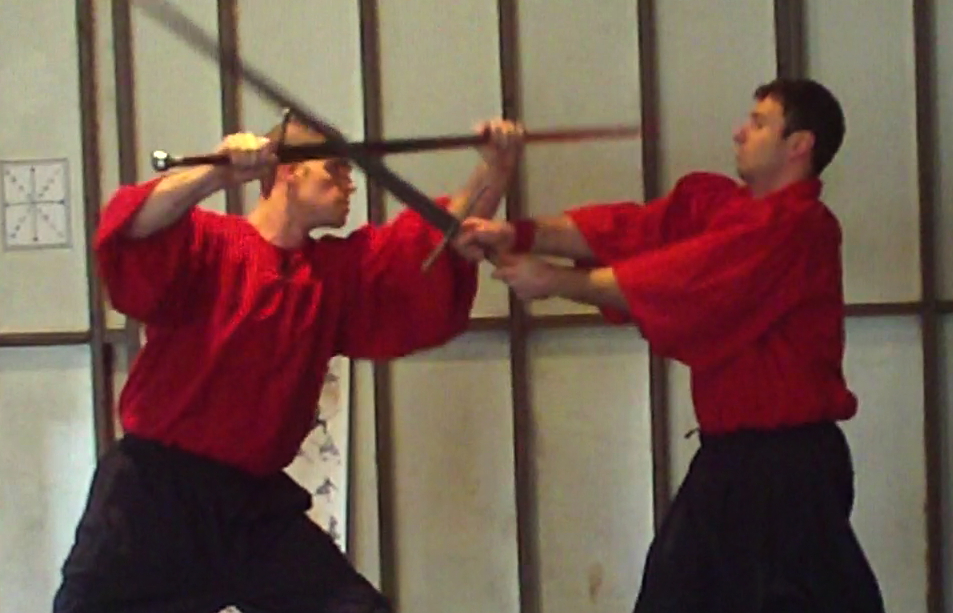
I also mentioned two grip styles, which you can see depicted above; Battering Point and Halfswording, respectively. Battering Point is a position where the sword is held by the blade in two hands, allowing devastating pommel smashes and Hook attempts. Halfswording is the Defensive Grip from Martial Arts, applied to a two-handed sword. Both of these grip styles almost universally appear in the fighting manuals from the 15th century. I think that the handling of these grips can be improved.

There has been a lot of information unearthed from the Historical European Martial Arts crowd and archeological findings over the time since MA has been published. Our understanding of armored combat is better. We understand now that the Pollaxe and Dueling Halberd were actually more common than was thought at the time of publication, and we also have a better idea of why these alternate grip styles are so vital.

For instance, Longsword Fighting in Martial Arts states that stylists would often use Committed Attacks from the normal grip to injure adversaries 'through' armor. There have been a few tests of that concept:


They're fairly conclusive. So, how can we modify the existing Defensive Grip rules to catch up to what we've figured out about armored fighting? Let's take the two examples of alternate grips one at a time.


Halfswording


The Half-sword position is the classic example of a Defensive Grip, offering +1 to parry, +1 to thrusting damage, and -2 to swung damage. This is a good place to start. However, there are some parts of the implementation I must disagree with.

First of all, in order to target armor gaps more effectively, you have to take an alternate version of the Defensive Grip, which Martial Arts describes as placing the off hand 'just behind the tip' of the blade. This special, unnamed grip drops damage to thrust impaling. It also drops the sword to reach C. Is this accurate?

Ahistorical images, historical technique. (Source)
As far as I know, this supposed 'different grip' is fiction. I have never seen a halfsword technique where the hand was placed any further than halfway up the blade. In fact, I daresay that that would be uncomfortable, and it would make point control worse. Halfswording can drop almost any sword to reach C without any significant loss in thrusting power. Retaining full Reach while in a Defensive Grip, actually, is close to impossible - your sword WILL be significantly shortened. And it is certain that this "regular" defensive grip gives better point control than a supposed stance with the hand behind the tip of the sword. I can vouch personally for that.

We see this grip continually depicted over and over and over in historical sources. Rarely does it waver from being placed firmly in the center of the blade. When it varies, it is to place the hand on the ricasso, not near the tip. Always, it is depicted lowering reach, and it is depicted to aid point control, and always is the ensuing grip used for parrying weapons or stabbing into armor gaps, or grappling. These men wore voiders - little bits of DR 3 mail - that covered their armpits and the inside of their elbows. If thrust damage was really dropped that much by targeting gaps, it would be almost impossible to cripple someone by stabbing them in the armpit.

The fix:

-For swords, in addition to the stated standard effects for a Defensive Grip in Martial Arts, a Defensive Grip drops reach to C, 1, the +1 thrusting damage bonus is negated, and -2 is removed from penalties to attack gaps. These effects are mandatory and replace the 'just behind the tip' rules in their entirety. In addition, this grip gives +1 to Pummeling damage.


Battering Point

Aka, the "Inverse Grip"


Describing the Battering Point grip requires a new grip style. This style of blade-gripping is referenced in Martial Arts, but no rules are given for it. We'll call it "Inverse Grip" for genericism reasons.

Inverse Grip can be assumed with any sword under the same rules as a Defensive Grip, being affected by Grip Mastery the same way that stance is. Like the Defensive Grip, it requires two hands. While so gripped, Swung attacks gain +1 to damage and become crushing. Reach is unchanged. The weapon is also unbalanced, unless the wielder has 1.5 the required ST for the weapon's normal Swing. The weapon can be used with the rules under Hook if it has a crossguard. The wielder can also choose to attack for swung impaling damage with his crossguard, based off the weapon's normal Swung damage. In addition to potentially getting stuck, roll versus the weapon's HT each time an attack hits home - a failure means the crossguard breaks and the sword has -1 to Parry until it is repaired.

All attacks from this grip are (normally) under the domain of Two-Handed Axe/Mace.

A weapon such as a katana, with no pommel, or a non-sword object simply has its damage change to crushing. None of the other rules above apply, although the weapon still becomes used with Two-Handed Axe/Mace. Thus, this grip is rather pointless unless seeking to subdue a target without (as much) harm.

Try this with any kind of sword. Even shorter blades can be wielded with pommel strikes - Broadsword, Shortsword and Falchion alike could all have benefits when used two-handed to beat people over the head. May your swordpommel uproot many teeth!

Naked Steel and Ambition Part 1: Gripping a blade in bare hands?


Would you ever grab a sharp blade with your bare hands?

When an armored knight faces another armored knight, rarely does it resemble the battles so often depicted in film and television. Penetrating metal armor with a metal weapon is a near impossibility. Fortunately, as Martial Arts states, the fighting manuals from the 14th and 15th centuries have the answer to how you would use a sword to deal with an armored man.

There are two alternate grip styles that are common in these manuals. One is called Halfswording, which involves putting one's off hand on the blade of the sword, converting it into a short-ranged spear that can target gaps in armor or smash the target with the pommel, or be wrapped around the target for grappling. This is simulated by the Defensive Grip rules in Martial Arts.

The other is called the Battering Point, and it involves putting both hands on the blade of the sword, and swinging the entire thing as a mace, or as a pick, using the sharpened crossguard or the pommel as an impact surface to wound the target through their armor. As far as I know, there are no rules for this in Martial Arts. It is referenced obliquely, but no rules are given for employing it.


At this point, you may be thinking, merely from watching and looking at this, something along the lines of "How in God's name do they not cut themselves?" Or perhaps  "Surely they must have been wearing gloves, or wearing gauntlets?" Indeed, Martial Arts is no different - at two points it subscribes to the belief that doing this is somehow ill-advised. Performing a Choke Hold with an edged weapon, by wrapping it around their neck in the half-sword grip, requires a DX roll, the consequences for failure being thrust cutting damage to the wielder's own hands (Martial Arts, p69). The description for the Hook technique implies that any sane user would be wearing gauntlets to attempt to grasp the blade as described in the fighting manuals. The general omission of rules for the blade-holding grip also strike me as a result of the incredulity this concept faces from those of us who have never studied knightly martial arts. This idea must surely be fanciful, ludicrous, or insanely dangerous, so many people have told me.


Sad to say, these people are wrong. Edged weapons are not lightsabers - they do not cut from simply being in contact. The principle can be understood if you've ever cleaned a combat knife, or even if you've ever cut bread or an undercooked steak - simply pressing on the meat or bread does not cut it, it crushes it. It is the lateral motion of slicing, or sawing, or hewing that causes damage, not simply being in contact with the edge.

The secret to this, in real life, is as simple as gripping the blade like a guitar. Grip with the fingers and flat of the palm, and grip firmly, so the sword does not slide around in your hands, and you have a grip that will never cut you

There could be some argument that a slip-up in this condition could be dangerous, and could cut your hand. But could any injury sustained from the blade simply moving along your hand really take you out of the fight? I doubt any such injury would be worth more than a single point of damage. When adrenaline is going, a mere cut on your hand is a small price to pay for the tactical flexibility these stances and grips give you.

I feel that fighting manuals would not continually depict this kind of grip if it was at all dangerous to an experienced user. It's certainly no more dangerous than holding an edged weapon by the hilt is, which already places the user at risk regardless of where his hands are. The slew of accidents, minor and not so minor, that anyone who works around knives can attest to, is certainly proof of that. You could drop a sharp weapon and injure yourself, or even fall atop it, yet GURPS doesn't ask you to make a DX roll to avoid impaling yourself if you fall down while holding a weapon. Such catastrophic self-injury is best reserved for critical failures to begin with.

The fixes here are quite simple, and actually make things less complex.

-Self-injury is impossible if a character trying a blade-gripping technique or stance has combat skills and familiarity with the weapon in question. Do away with all references to it.

-At the GM's option, if a character has no combat skills or is unfamiliar with a given weapon and has a hand on the blade of any sort, roll a DX check after each combat turn in which the character used the sword to parry or attack. Failure means 1 point of cutting damage to the hand. Palm armor protects normally. This can add up over time (consider crippling the hand if aggregated injury exceeds HP/3), making halfswording for a complete novice a bad idea.

In the next post on Naked Steel and Ambition, we'll cover the two types of grip and how to make them more true to the 15th century armored combat paradigm in GURPS rules. Until then, may your hand feel nothing but firm steel!