Showing posts with label weapons. Show all posts

Tuesday, 27 May 2014

Gadgets and Gewgaws: Miscellaneous Low-Tech equipment and rules


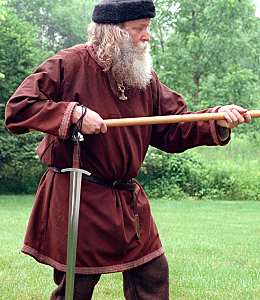
"But it was Egill and not a bear that was hiding in the bushes, and when he saw Berg-Önundur, he drew his sword. There was a loop on the hilt which he drew over his hand to let the sword hang there. He took his spear in his hand and rushed towards Berg-Önundur."
 -Egil's Saga, ch. 58

GURPS Low-Tech contains many amazing things, almost to the point of being, in and of itself, an educational book. Each time I read it I learn something I haven't known before. Yet in listing all the aspects of daily life, many of the things more pertinent to adventurers and soldiers have been omitted. History is filled with all sorts of little artifacts and mentions of things that warriors did to give them the edge, and I'm often asked, personally, as a GM, about getting these things. Gadgets and Gewgaws will be a listing of various rules and stats I have come up with for accessories not covered in the -Tech books.

As a brief aside, the historical accuracy of some of these items is in debate, or is up in the air entirely. Cloth or leather accessories do not survive the ages well, usually rotting away to nothing, and many metal objects are unrecognizable hunks of rust. This makes it very hard to tell whether such a thing as, for instance, the Rain Scabbard, ever existed.  I, personally, am of the mindset that if an idea makes sense, someone in history, at some point, must surely have tried it. We cannot conclude such things were common in history without evidence, but fantasy worlds or historical settings are free to include them.


Sword Lanyard
$1, 0.1 lbs

A sword lanyard is a piece of string or twine wrapped around the wrist of a swordsman, in order to suspend a weapon hanging point-down from the wrist, leaving his hand free for other tasks. So suspended, a weapon can be quickly readied with a flick of the hand (+2 to Fast-Draw), but Holdout rolls are impossible. The lanyard must be re-tied to the weapon each time it is drawn (three Ready maneuvers, cut to two if a successful Knot-Tying roll is made), making it primarily useful for when preparing for an engagement ahead of time. The sword cannot be dropped, merely made unready, unless the twine is cut (-8 to hit, 1 HP, 1 DR). Any weapon longer than a Broadsword will interfere with the hand it's attached to, giving -2 to DX with that hand (-1 if the hand is participating in readying a two-handed weapon).

The lanyard is made of a piece of plant fiber twine about five yards long and can support 20 lbs. A similar lanyard can be made of chain and attached to a gauntlet ($10, 1 lbs), and is identical aside from being much tougher. A clasp to quickly detach a chain lanyard is $5, neg.


Peace Bonds
$3, 0.1 lbs
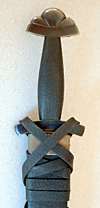
"The lad grasped the sword, drew off a step or two, snapped off the peace-strings, and drew the sword."
                        -Gisla Saga, Chapter 28

A pair of leather loops for the mouth of a sword scabbard that can slide up and around the crossguard in order to secure the sword in the scabbard. This adds an extra Ready maneuver to any draw, in order to slip the straps outwards around the crosshilt and off the sword. The extra Ready can be avoided by a Fast-Draw roll at -4. The sword cannot be drawn by anyone else while so secured, though, and it will also stay in the scabbard even if the sword is tugged or tossed, or turned upside down. Peace bonds such as these are primarily used as a statement of trust, rather than by legal obligation, showing the swordsman feels no need to (quickly) draw his weapon.


Peace Bonds, Tied
$7, 0.25 lbs

A more complicated system of tight, knotted cords or leather straps that ensure at least one knot must be untied in order to draw a scabbarded weapon. This requires three Ready maneuvers, cut to two on a successful Knot-Tying or Escape roll. Drawing the weapon is still impossible until this is done, or the cords are cut. This particular style of peace bond can be demanded by law, in order to wear or carry a sword in places such as holy ground, a designated meeting point, or in a city with restrictive weapon laws. Not all places will accept a peace-bonded sword automatically, but it certainly speaks volumes about a blade-carrier's intent.


Rain Scabbard
$10, 1.5 lb

This thick, elongated cloth bag can be tied over any weapon up to Bastard Sword lengths (4.5 feet), including a sword still in its scabbard. With the flap closed over the end, the weapon is at -2 to Fast-Draw, but it also gains +4 HT against environmental degradation. A larger version to cover greatswords, etc (up to 8 feet long) is $17, 2 lbs. The weapon can be slung on a person while in the rain scabbard at no penalty. The scabbard will protect against rain, mud, magical corrosive dust, etc, but will not protect against immersion in liquid.

Although a specialty item, the rain scabbard can be given an inner lining and specialized flap that will not leak when submerged, provided it encloses the entire weapon. Drawing or opening the scabbard will flood the contents, however. This upgrade is an additional $50 and 0.5 lbs.

Whether any such historical item of this type exists is unknown, but it would certainly be at home in any fantasy setting.


Visor Lock
$25, 0.1 lbs
(Cost multiplied by SM)

A visor lock is a small but sturdy key that slips into a visor's pivot, in order to lock the visor in the closed position, preventing it from being raised or knocked open accidentally. This can be very valuable if grappled by an opponent! Engaging it requires two Ready maneuvers, removing it requires one - but disengaging the visor lock of a resisting opponent requires a quick contest of grappling skill! (In either case, the time to ready or unready can be lowered by one second with a successful DX roll, penalized for Hamfisted.)

Without a visor lock, a visor can be raised by anyone who successfully grapples the wearer's face as a free action.

Visor locks can be broken - in fact, the duel of Jacques Le Gris and Jean de Carrouges was concluded when Carrouges smashed open Le Gris's visor with the pommel of his sword, breaking the lock that held it in place. Carrouges then finished his unfortunate opponent by stabbing him through the jaw with a dagger. The lock has DR 4, HP 6. If the visor it is attached to is struck, apply the same amount of basic damage to the visor lock. When destroyed, it ceases to function and the visor can be raised by anyone grappling the face.


Visor Bars
1% of armor cost and weight

Due to the threat posed by adversaries slipping a dagger or sword point in through the vision slit of a visor or full helmet, some visored helmets feature vertical bars arrayed over the visor slit. These bars impair vision, but provide protection to the eyes. Partial bars, like those pictured on the right, give 3/6 coverage to the eyes, but give Tunnel Vision instead of No Peripheral Vision!

Full bars are 2% of full armor cost and weight and, in addition to granting Tunnel Vision, also give -2 to vision rolls. However, they provide full protection (6/6) to the eyes.

Bypassing visor bars is impossible for creatures using same-size SM weapons, unless attacking with something like a needle. SM-3 or smaller weaponry may be able to manage it. However, normally, with full bars in place, the Eye Slit armor gap is protected by the full DR of the visor bars.

Wednesday, 7 May 2014

Naked Steel and Ambition Part 2: Coming to grips with your sword


In my last post, I discussed how laying hands on a sword blade wasn't as strange an idea as an average person might think.

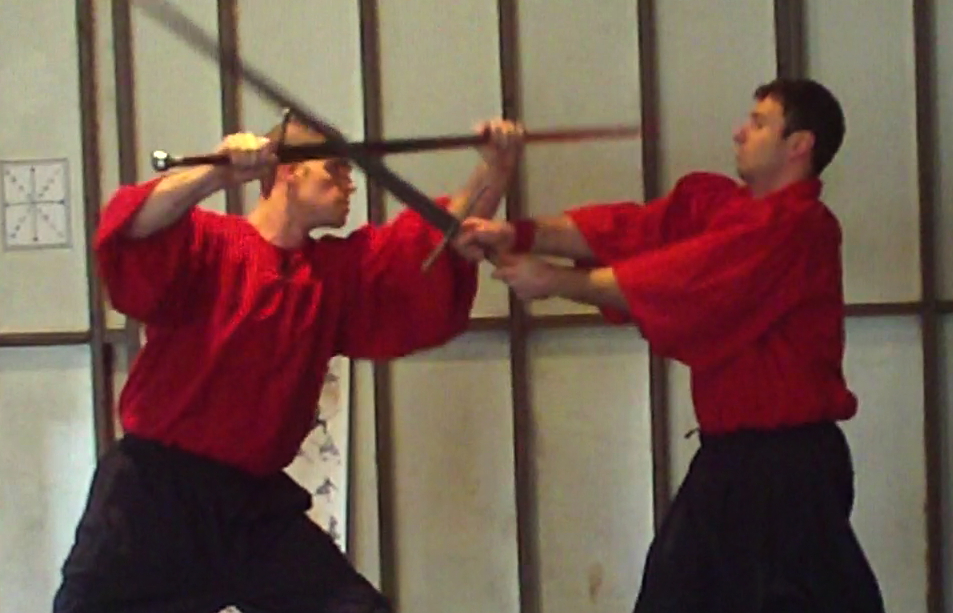
I also mentioned two grip styles, which you can see depicted above; Battering Point and Halfswording, respectively. Battering Point is a position where the sword is held by the blade in two hands, allowing devastating pommel smashes and Hook attempts. Halfswording is the Defensive Grip from Martial Arts, applied to a two-handed sword. Both of these grip styles almost universally appear in the fighting manuals from the 15th century. I think that the handling of these grips can be improved.

There has been a lot of information unearthed from the Historical European Martial Arts crowd and archeological findings over the time since MA has been published. Our understanding of armored combat is better. We understand now that the Pollaxe and Dueling Halberd were actually more common than was thought at the time of publication, and we also have a better idea of why these alternate grip styles are so vital.

For instance, Longsword Fighting in Martial Arts states that stylists would often use Committed Attacks from the normal grip to injure adversaries 'through' armor. There have been a few tests of that concept:


They're fairly conclusive. So, how can we modify the existing Defensive Grip rules to catch up to what we've figured out about armored fighting? Let's take the two examples of alternate grips one at a time.


Halfswording


The Half-sword position is the classic example of a Defensive Grip, offering +1 to parry, +1 to thrusting damage, and -2 to swung damage. This is a good place to start. However, there are some parts of the implementation I must disagree with.

First of all, in order to target armor gaps more effectively, you have to take an alternate version of the Defensive Grip, which Martial Arts describes as placing the off hand 'just behind the tip' of the blade. This special, unnamed grip drops damage to thrust impaling. It also drops the sword to reach C. Is this accurate?

Ahistorical images, historical technique. (Source)
As far as I know, this supposed 'different grip' is fiction. I have never seen a halfsword technique where the hand was placed any further than halfway up the blade. In fact, I daresay that that would be uncomfortable, and it would make point control worse. Halfswording can drop almost any sword to reach C without any significant loss in thrusting power. Retaining full Reach while in a Defensive Grip, actually, is close to impossible - your sword WILL be significantly shortened. And it is certain that this "regular" defensive grip gives better point control than a supposed stance with the hand behind the tip of the sword. I can vouch personally for that.

We see this grip continually depicted over and over and over in historical sources. Rarely does it waver from being placed firmly in the center of the blade. When it varies, it is to place the hand on the ricasso, not near the tip. Always, it is depicted lowering reach, and it is depicted to aid point control, and always is the ensuing grip used for parrying weapons or stabbing into armor gaps, or grappling. These men wore voiders - little bits of DR 3 mail - that covered their armpits and the inside of their elbows. If thrust damage was really dropped that much by targeting gaps, it would be almost impossible to cripple someone by stabbing them in the armpit.

The fix:

-For swords, in addition to the stated standard effects for a Defensive Grip in Martial Arts, a Defensive Grip drops reach to C, 1, the +1 thrusting damage bonus is negated, and -2 is removed from penalties to attack gaps. These effects are mandatory and replace the 'just behind the tip' rules in their entirety. In addition, this grip gives +1 to Pummeling damage.


Battering Point

Aka, the "Inverse Grip"


Describing the Battering Point grip requires a new grip style. This style of blade-gripping is referenced in Martial Arts, but no rules are given for it. We'll call it "Inverse Grip" for genericism reasons.

Inverse Grip can be assumed with any sword under the same rules as a Defensive Grip, being affected by Grip Mastery the same way that stance is. Like the Defensive Grip, it requires two hands. While so gripped, Swung attacks gain +1 to damage and become crushing. Reach is unchanged. The weapon is also unbalanced, unless the wielder has 1.5 the required ST for the weapon's normal Swing. The weapon can be used with the rules under Hook if it has a crossguard. The wielder can also choose to attack for swung impaling damage with his crossguard, based off the weapon's normal Swung damage. In addition to potentially getting stuck, roll versus the weapon's HT each time an attack hits home - a failure means the crossguard breaks and the sword has -1 to Parry until it is repaired.

All attacks from this grip are (normally) under the domain of Two-Handed Axe/Mace.

A weapon such as a katana, with no pommel, or a non-sword object simply has its damage change to crushing. None of the other rules above apply, although the weapon still becomes used with Two-Handed Axe/Mace. Thus, this grip is rather pointless unless seeking to subdue a target without (as much) harm.

Try this with any kind of sword. Even shorter blades can be wielded with pommel strikes - Broadsword, Shortsword and Falchion alike could all have benefits when used two-handed to beat people over the head. May your swordpommel uproot many teeth!

Naked Steel and Ambition Part 1: Gripping a blade in bare hands?


Would you ever grab a sharp blade with your bare hands?

When an armored knight faces another armored knight, rarely does it resemble the battles so often depicted in film and television. Penetrating metal armor with a metal weapon is a near impossibility. Fortunately, as Martial Arts states, the fighting manuals from the 14th and 15th centuries have the answer to how you would use a sword to deal with an armored man.

There are two alternate grip styles that are common in these manuals. One is called Halfswording, which involves putting one's off hand on the blade of the sword, converting it into a short-ranged spear that can target gaps in armor or smash the target with the pommel, or be wrapped around the target for grappling. This is simulated by the Defensive Grip rules in Martial Arts.

The other is called the Battering Point, and it involves putting both hands on the blade of the sword, and swinging the entire thing as a mace, or as a pick, using the sharpened crossguard or the pommel as an impact surface to wound the target through their armor. As far as I know, there are no rules for this in Martial Arts. It is referenced obliquely, but no rules are given for employing it.


At this point, you may be thinking, merely from watching and looking at this, something along the lines of "How in God's name do they not cut themselves?" Or perhaps  "Surely they must have been wearing gloves, or wearing gauntlets?" Indeed, Martial Arts is no different - at two points it subscribes to the belief that doing this is somehow ill-advised. Performing a Choke Hold with an edged weapon, by wrapping it around their neck in the half-sword grip, requires a DX roll, the consequences for failure being thrust cutting damage to the wielder's own hands (Martial Arts, p69). The description for the Hook technique implies that any sane user would be wearing gauntlets to attempt to grasp the blade as described in the fighting manuals. The general omission of rules for the blade-holding grip also strike me as a result of the incredulity this concept faces from those of us who have never studied knightly martial arts. This idea must surely be fanciful, ludicrous, or insanely dangerous, so many people have told me.


Sad to say, these people are wrong. Edged weapons are not lightsabers - they do not cut from simply being in contact. The principle can be understood if you've ever cleaned a combat knife, or even if you've ever cut bread or an undercooked steak - simply pressing on the meat or bread does not cut it, it crushes it. It is the lateral motion of slicing, or sawing, or hewing that causes damage, not simply being in contact with the edge.

The secret to this, in real life, is as simple as gripping the blade like a guitar. Grip with the fingers and flat of the palm, and grip firmly, so the sword does not slide around in your hands, and you have a grip that will never cut you

There could be some argument that a slip-up in this condition could be dangerous, and could cut your hand. But could any injury sustained from the blade simply moving along your hand really take you out of the fight? I doubt any such injury would be worth more than a single point of damage. When adrenaline is going, a mere cut on your hand is a small price to pay for the tactical flexibility these stances and grips give you.

I feel that fighting manuals would not continually depict this kind of grip if it was at all dangerous to an experienced user. It's certainly no more dangerous than holding an edged weapon by the hilt is, which already places the user at risk regardless of where his hands are. The slew of accidents, minor and not so minor, that anyone who works around knives can attest to, is certainly proof of that. You could drop a sharp weapon and injure yourself, or even fall atop it, yet GURPS doesn't ask you to make a DX roll to avoid impaling yourself if you fall down while holding a weapon. Such catastrophic self-injury is best reserved for critical failures to begin with.

The fixes here are quite simple, and actually make things less complex.

-Self-injury is impossible if a character trying a blade-gripping technique or stance has combat skills and familiarity with the weapon in question. Do away with all references to it.

-At the GM's option, if a character has no combat skills or is unfamiliar with a given weapon and has a hand on the blade of any sort, roll a DX check after each combat turn in which the character used the sword to parry or attack. Failure means 1 point of cutting damage to the hand. Palm armor protects normally. This can add up over time (consider crippling the hand if aggregated injury exceeds HP/3), making halfswording for a complete novice a bad idea.

In the next post on Naked Steel and Ambition, we'll cover the two types of grip and how to make them more true to the 15th century armored combat paradigm in GURPS rules. Until then, may your hand feel nothing but firm steel!