Showing posts with label armored combat. Show all posts

Tuesday, 27 May 2014

Gadgets and Gewgaws: Miscellaneous Low-Tech equipment and rules


"But it was Egill and not a bear that was hiding in the bushes, and when he saw Berg-Önundur, he drew his sword. There was a loop on the hilt which he drew over his hand to let the sword hang there. He took his spear in his hand and rushed towards Berg-Önundur."
 -Egil's Saga, ch. 58

GURPS Low-Tech contains many amazing things, almost to the point of being, in and of itself, an educational book. Each time I read it I learn something I haven't known before. Yet in listing all the aspects of daily life, many of the things more pertinent to adventurers and soldiers have been omitted. History is filled with all sorts of little artifacts and mentions of things that warriors did to give them the edge, and I'm often asked, personally, as a GM, about getting these things. Gadgets and Gewgaws will be a listing of various rules and stats I have come up with for accessories not covered in the -Tech books.

As a brief aside, the historical accuracy of some of these items is in debate, or is up in the air entirely. Cloth or leather accessories do not survive the ages well, usually rotting away to nothing, and many metal objects are unrecognizable hunks of rust. This makes it very hard to tell whether such a thing as, for instance, the Rain Scabbard, ever existed.  I, personally, am of the mindset that if an idea makes sense, someone in history, at some point, must surely have tried it. We cannot conclude such things were common in history without evidence, but fantasy worlds or historical settings are free to include them.


Sword Lanyard
$1, 0.1 lbs

A sword lanyard is a piece of string or twine wrapped around the wrist of a swordsman, in order to suspend a weapon hanging point-down from the wrist, leaving his hand free for other tasks. So suspended, a weapon can be quickly readied with a flick of the hand (+2 to Fast-Draw), but Holdout rolls are impossible. The lanyard must be re-tied to the weapon each time it is drawn (three Ready maneuvers, cut to two if a successful Knot-Tying roll is made), making it primarily useful for when preparing for an engagement ahead of time. The sword cannot be dropped, merely made unready, unless the twine is cut (-8 to hit, 1 HP, 1 DR). Any weapon longer than a Broadsword will interfere with the hand it's attached to, giving -2 to DX with that hand (-1 if the hand is participating in readying a two-handed weapon).

The lanyard is made of a piece of plant fiber twine about five yards long and can support 20 lbs. A similar lanyard can be made of chain and attached to a gauntlet ($10, 1 lbs), and is identical aside from being much tougher. A clasp to quickly detach a chain lanyard is $5, neg.


Peace Bonds
$3, 0.1 lbs
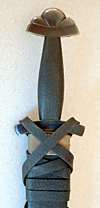
"The lad grasped the sword, drew off a step or two, snapped off the peace-strings, and drew the sword."
                        -Gisla Saga, Chapter 28

A pair of leather loops for the mouth of a sword scabbard that can slide up and around the crossguard in order to secure the sword in the scabbard. This adds an extra Ready maneuver to any draw, in order to slip the straps outwards around the crosshilt and off the sword. The extra Ready can be avoided by a Fast-Draw roll at -4. The sword cannot be drawn by anyone else while so secured, though, and it will also stay in the scabbard even if the sword is tugged or tossed, or turned upside down. Peace bonds such as these are primarily used as a statement of trust, rather than by legal obligation, showing the swordsman feels no need to (quickly) draw his weapon.


Peace Bonds, Tied
$7, 0.25 lbs

A more complicated system of tight, knotted cords or leather straps that ensure at least one knot must be untied in order to draw a scabbarded weapon. This requires three Ready maneuvers, cut to two on a successful Knot-Tying or Escape roll. Drawing the weapon is still impossible until this is done, or the cords are cut. This particular style of peace bond can be demanded by law, in order to wear or carry a sword in places such as holy ground, a designated meeting point, or in a city with restrictive weapon laws. Not all places will accept a peace-bonded sword automatically, but it certainly speaks volumes about a blade-carrier's intent.


Rain Scabbard
$10, 1.5 lb

This thick, elongated cloth bag can be tied over any weapon up to Bastard Sword lengths (4.5 feet), including a sword still in its scabbard. With the flap closed over the end, the weapon is at -2 to Fast-Draw, but it also gains +4 HT against environmental degradation. A larger version to cover greatswords, etc (up to 8 feet long) is $17, 2 lbs. The weapon can be slung on a person while in the rain scabbard at no penalty. The scabbard will protect against rain, mud, magical corrosive dust, etc, but will not protect against immersion in liquid.

Although a specialty item, the rain scabbard can be given an inner lining and specialized flap that will not leak when submerged, provided it encloses the entire weapon. Drawing or opening the scabbard will flood the contents, however. This upgrade is an additional $50 and 0.5 lbs.

Whether any such historical item of this type exists is unknown, but it would certainly be at home in any fantasy setting.


Visor Lock
$25, 0.1 lbs
(Cost multiplied by SM)

A visor lock is a small but sturdy key that slips into a visor's pivot, in order to lock the visor in the closed position, preventing it from being raised or knocked open accidentally. This can be very valuable if grappled by an opponent! Engaging it requires two Ready maneuvers, removing it requires one - but disengaging the visor lock of a resisting opponent requires a quick contest of grappling skill! (In either case, the time to ready or unready can be lowered by one second with a successful DX roll, penalized for Hamfisted.)

Without a visor lock, a visor can be raised by anyone who successfully grapples the wearer's face as a free action.

Visor locks can be broken - in fact, the duel of Jacques Le Gris and Jean de Carrouges was concluded when Carrouges smashed open Le Gris's visor with the pommel of his sword, breaking the lock that held it in place. Carrouges then finished his unfortunate opponent by stabbing him through the jaw with a dagger. The lock has DR 4, HP 6. If the visor it is attached to is struck, apply the same amount of basic damage to the visor lock. When destroyed, it ceases to function and the visor can be raised by anyone grappling the face.


Visor Bars
1% of armor cost and weight

Due to the threat posed by adversaries slipping a dagger or sword point in through the vision slit of a visor or full helmet, some visored helmets feature vertical bars arrayed over the visor slit. These bars impair vision, but provide protection to the eyes. Partial bars, like those pictured on the right, give 3/6 coverage to the eyes, but give Tunnel Vision instead of No Peripheral Vision!

Full bars are 2% of full armor cost and weight and, in addition to granting Tunnel Vision, also give -2 to vision rolls. However, they provide full protection (6/6) to the eyes.

Bypassing visor bars is impossible for creatures using same-size SM weapons, unless attacking with something like a needle. SM-3 or smaller weaponry may be able to manage it. However, normally, with full bars in place, the Eye Slit armor gap is protected by the full DR of the visor bars.

Wednesday, 7 May 2014

Naked Steel and Ambition Part 2: Coming to grips with your sword


In my last post, I discussed how laying hands on a sword blade wasn't as strange an idea as an average person might think.

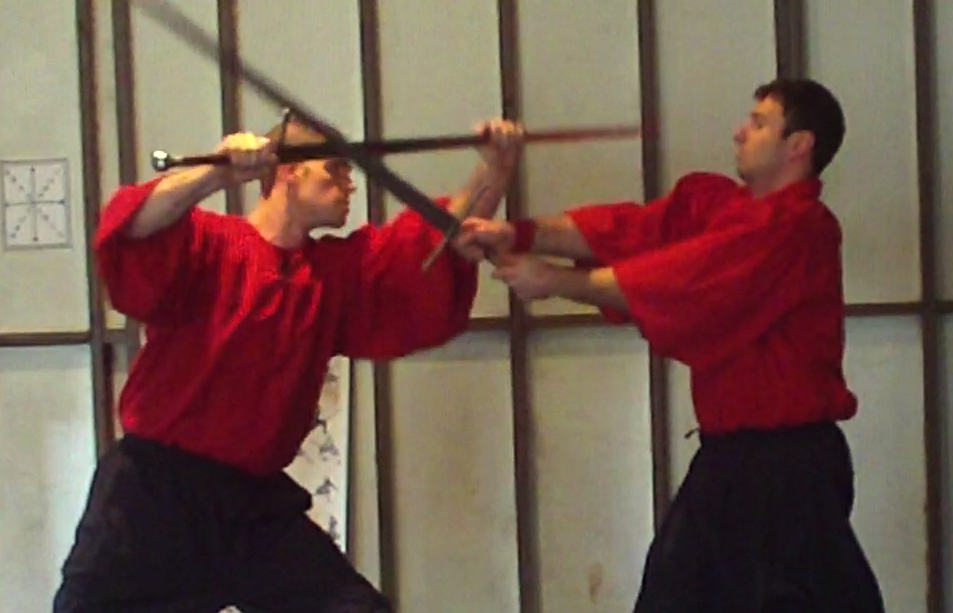
I also mentioned two grip styles, which you can see depicted above; Battering Point and Halfswording, respectively. Battering Point is a position where the sword is held by the blade in two hands, allowing devastating pommel smashes and Hook attempts. Halfswording is the Defensive Grip from Martial Arts, applied to a two-handed sword. Both of these grip styles almost universally appear in the fighting manuals from the 15th century. I think that the handling of these grips can be improved.

There has been a lot of information unearthed from the Historical European Martial Arts crowd and archeological findings over the time since MA has been published. Our understanding of armored combat is better. We understand now that the Pollaxe and Dueling Halberd were actually more common than was thought at the time of publication, and we also have a better idea of why these alternate grip styles are so vital.

For instance, Longsword Fighting in Martial Arts states that stylists would often use Committed Attacks from the normal grip to injure adversaries 'through' armor. There have been a few tests of that concept:


They're fairly conclusive. So, how can we modify the existing Defensive Grip rules to catch up to what we've figured out about armored fighting? Let's take the two examples of alternate grips one at a time.


Halfswording


The Half-sword position is the classic example of a Defensive Grip, offering +1 to parry, +1 to thrusting damage, and -2 to swung damage. This is a good place to start. However, there are some parts of the implementation I must disagree with.

First of all, in order to target armor gaps more effectively, you have to take an alternate version of the Defensive Grip, which Martial Arts describes as placing the off hand 'just behind the tip' of the blade. This special, unnamed grip drops damage to thrust impaling. It also drops the sword to reach C. Is this accurate?

Ahistorical images, historical technique. (Source)
As far as I know, this supposed 'different grip' is fiction. I have never seen a halfsword technique where the hand was placed any further than halfway up the blade. In fact, I daresay that that would be uncomfortable, and it would make point control worse. Halfswording can drop almost any sword to reach C without any significant loss in thrusting power. Retaining full Reach while in a Defensive Grip, actually, is close to impossible - your sword WILL be significantly shortened. And it is certain that this "regular" defensive grip gives better point control than a supposed stance with the hand behind the tip of the sword. I can vouch personally for that.

We see this grip continually depicted over and over and over in historical sources. Rarely does it waver from being placed firmly in the center of the blade. When it varies, it is to place the hand on the ricasso, not near the tip. Always, it is depicted lowering reach, and it is depicted to aid point control, and always is the ensuing grip used for parrying weapons or stabbing into armor gaps, or grappling. These men wore voiders - little bits of DR 3 mail - that covered their armpits and the inside of their elbows. If thrust damage was really dropped that much by targeting gaps, it would be almost impossible to cripple someone by stabbing them in the armpit.

The fix:

-For swords, in addition to the stated standard effects for a Defensive Grip in Martial Arts, a Defensive Grip drops reach to C, 1, the +1 thrusting damage bonus is negated, and -2 is removed from penalties to attack gaps. These effects are mandatory and replace the 'just behind the tip' rules in their entirety. In addition, this grip gives +1 to Pummeling damage.


Battering Point

Aka, the "Inverse Grip"


Describing the Battering Point grip requires a new grip style. This style of blade-gripping is referenced in Martial Arts, but no rules are given for it. We'll call it "Inverse Grip" for genericism reasons.

Inverse Grip can be assumed with any sword under the same rules as a Defensive Grip, being affected by Grip Mastery the same way that stance is. Like the Defensive Grip, it requires two hands. While so gripped, Swung attacks gain +1 to damage and become crushing. Reach is unchanged. The weapon is also unbalanced, unless the wielder has 1.5 the required ST for the weapon's normal Swing. The weapon can be used with the rules under Hook if it has a crossguard. The wielder can also choose to attack for swung impaling damage with his crossguard, based off the weapon's normal Swung damage. In addition to potentially getting stuck, roll versus the weapon's HT each time an attack hits home - a failure means the crossguard breaks and the sword has -1 to Parry until it is repaired.

All attacks from this grip are (normally) under the domain of Two-Handed Axe/Mace.

A weapon such as a katana, with no pommel, or a non-sword object simply has its damage change to crushing. None of the other rules above apply, although the weapon still becomes used with Two-Handed Axe/Mace. Thus, this grip is rather pointless unless seeking to subdue a target without (as much) harm.

Try this with any kind of sword. Even shorter blades can be wielded with pommel strikes - Broadsword, Shortsword and Falchion alike could all have benefits when used two-handed to beat people over the head. May your swordpommel uproot many teeth!

Naked Steel and Ambition Part 1: Gripping a blade in bare hands?


Would you ever grab a sharp blade with your bare hands?

When an armored knight faces another armored knight, rarely does it resemble the battles so often depicted in film and television. Penetrating metal armor with a metal weapon is a near impossibility. Fortunately, as Martial Arts states, the fighting manuals from the 14th and 15th centuries have the answer to how you would use a sword to deal with an armored man.

There are two alternate grip styles that are common in these manuals. One is called Halfswording, which involves putting one's off hand on the blade of the sword, converting it into a short-ranged spear that can target gaps in armor or smash the target with the pommel, or be wrapped around the target for grappling. This is simulated by the Defensive Grip rules in Martial Arts.

The other is called the Battering Point, and it involves putting both hands on the blade of the sword, and swinging the entire thing as a mace, or as a pick, using the sharpened crossguard or the pommel as an impact surface to wound the target through their armor. As far as I know, there are no rules for this in Martial Arts. It is referenced obliquely, but no rules are given for employing it.


At this point, you may be thinking, merely from watching and looking at this, something along the lines of "How in God's name do they not cut themselves?" Or perhaps  "Surely they must have been wearing gloves, or wearing gauntlets?" Indeed, Martial Arts is no different - at two points it subscribes to the belief that doing this is somehow ill-advised. Performing a Choke Hold with an edged weapon, by wrapping it around their neck in the half-sword grip, requires a DX roll, the consequences for failure being thrust cutting damage to the wielder's own hands (Martial Arts, p69). The description for the Hook technique implies that any sane user would be wearing gauntlets to attempt to grasp the blade as described in the fighting manuals. The general omission of rules for the blade-holding grip also strike me as a result of the incredulity this concept faces from those of us who have never studied knightly martial arts. This idea must surely be fanciful, ludicrous, or insanely dangerous, so many people have told me.


Sad to say, these people are wrong. Edged weapons are not lightsabers - they do not cut from simply being in contact. The principle can be understood if you've ever cleaned a combat knife, or even if you've ever cut bread or an undercooked steak - simply pressing on the meat or bread does not cut it, it crushes it. It is the lateral motion of slicing, or sawing, or hewing that causes damage, not simply being in contact with the edge.

The secret to this, in real life, is as simple as gripping the blade like a guitar. Grip with the fingers and flat of the palm, and grip firmly, so the sword does not slide around in your hands, and you have a grip that will never cut you. 

There could be some argument that a slip-up in this condition could be dangerous, and could cut your hand. But could any injury sustained from the blade simply moving along your hand really take you out of the fight? I doubt any such injury would be worth more than a single point of damage. When adrenaline is going, a mere cut on your hand is a small price to pay for the tactical flexibility these stances and grips give you.

I feel that fighting manuals would not continually depict this kind of grip if it was at all dangerous to an experienced user. It's certainly no more dangerous than holding an edged weapon by the hilt is, which already places the user at risk regardless of where his hands are. The slew of accidents, minor and not so minor, that anyone who works around knives can attest to, is certainly proof of that. You could drop a sharp weapon and injure yourself, or even fall atop it, yet GURPS doesn't ask you to make a DX roll to avoid impaling yourself if you fall down while holding a weapon. Such catastrophic self-injury is best reserved for critical failures to begin with.

The fixes here are quite simple, and actually make things less complex.

-Self-injury is impossible if a character trying a blade-gripping technique or stance has combat skills and familiarity with the weapon in question. Do away with all references to it.

-At the GM's option, if a character has no combat skills or is unfamiliar with a given weapon and has a hand on the blade of any sort, roll a DX check after each combat turn in which the character used the sword to parry or attack. Failure means 1 point of cutting damage to the hand. Palm armor protects normally. This can add up over time (consider crippling the hand if aggregated injury exceeds HP/3), making halfswording for a complete novice a bad idea.

In the next post on Naked Steel and Ambition, we'll cover the two types of grip and how to make them more true to the 15th century armored combat paradigm in GURPS rules. Until then, may your hand feel nothing but firm steel!

Monday, 5 May 2014

Help, I Can't Hold My Sword: A short post on gauntlets


One more post on the nature of armor, then we'll move on. I swear.

This is another short one. Let me quote from Low Tech: Instant Armor: "Enclosed mittens and gloves protect vs. cold, heat, contact poison, etc., but give Bad Grip 1(p. B123). (Gauntlets lack this note – they’re open-palmed, negating both the benefit and the drawback.)"

Let's briefly discuss what this means. First of all, this means that anyone using mittens or low-tech gloves effectively has a -2 to their combat skills involving anything but unarmed striking, since that's essentially what Bad Grip does. -2 might not sound like a whole lot, but remember, 3d6 is a bell curve. For a user with skill 12, this drops his chance to hit by 24%! Wow. That's abysmal, especially in armored combat where tough hit locations will be targeted all the time.

Well, you can use gauntlets to get around this, as stated. However, note what that note says. All gauntlets are completely open palmed... and the benefits of having gloves on are negated. That means your gauntleted character has bare skin in contact with his blade. He is vulnerable to frostbite, burns, contact poison smeared on a doorknob...

Take a look at that image at the top. There are curiously few images available of modern reproduction gauntlets on the underside; I suppose this is because it isn't very photogenic. Even so, if you google 'gauntlet' you can easily note how leather gloves are almost universally a thing worn underneath them, often affixed permanently to them. Would a contact poison get through these gloves? Are they so whisper-thin that they do nothing against cold?

Even if you wear leather gloves under your gauntlet, Low Tech will tell you the same thing - Low Tech gloves give Bad Grip 1. I guess it's a choice between frostbite and not being able to swing your sword.

I understand low-tech gloves and mittens having Hamfisted. That makes perfect sense. I have a pair of kevlar gauntlets for swordfighting training, and I could end up standing there for a few minutes if I really tried to take my keys out of my pocket without taking them off first. However, Bad Grip is extremely excessive, especially for a leather glove. Even a mitten will do many things to you, but I highly doubt that it will subtract 24% from your chance to hit.

If this was true in reality, the instant someone put any kind of leather gloves or mittens on, their combat performance would measurably and noticeably decrease. Instead, when I put those kevlar gloves on, my performance improves. My hand-sweat is no longer interfering with the operation of my waster. These gloves have no high-tech grippy bits, they are completely smooth on the underside aside from a machine stitching line. And they're not exceptionally well fitted for me, either.

So, how do we fix this? Very simple:

-Gloves and gauntlets of any type do not give Bad Grip if they provide only DR 0 or DR 0*. Any palm armor that provides DR 1 or higher provides Bad Grip 1.

-Gauntlets do not protect the palm by themselves, but can be combined with other armor. If your gauntlets have a built-in leather glove, as most do, buy the glove as a Combination Gadget with the gauntlet. Otherwise, simply wear gloves under your gauntlets. 'Gloves' and 'Gauntlets' are separate armor location (hand front, hand back, you could think of it) and do not incur a layering penalty.

-Ordinary Low-Tech gloves give Hamfisted 1 if worn alone, unless they are made Expensive as per Low-Tech - in which case they provide no penalty.

-The total amount of Hamfisted for gloves and gauntlets cannot exceed Hamfisted 2.

I'm not, myself, entirely convinced that DR 1 on the palms automatically drops combat performance so much, but really, at some point, this becomes a gripe against Bad Grip rather than against Low-Tech armor. Perhaps in a future post I will cover my 'never-ever disadvantages' and how to improve them.

For now, though, may your grip on your sword be ever secure!

Sunday, 4 May 2014

Iron Joints: Why giving full rigid DR against joint locks makes absolutely no sense


"When I see that with the sword I could do nothing to you, instantly I use this catch from grappling, so that I believe and see and feel that your armor will be worth nothing as I force you the strong Lower Bind."
 -Fiore de'i Liberi
I'm here to talk about arm locks. Specifically, how they work versus rigid armor, in GURPS.

In GURPS, arm locks are protected against by rigid DR. To quote Martial Arts: "If you win, you inflict crushing damage equal to your margin of victory. The target’s rigid DR protects normally. Flexible armor, including natural DR with the Flexible or Tough Skin limitation, has no effect."

This means someone with DR 6 plate armor on their arm thus has DR 6 effective versus an arm lock. Even a Throw from Lock might not break his arm - the plates on his arm somehow bind together in a manner that prevents his elbow ligaments from shattering.

Yet at the same time, a Choke Hold has no such restriction! It's not stated in the Basic Set, nor in Martial Arts, that rigid armor protects against choke holds. This means that the best option against an armored man when you are unarmed isn't to break his limbs, it's to choke him out, even if he has a rigid gorget!

I ran into this problem facefirst when trying to come up with a way to run a powered-armor wrestling tournament in GURPS. Worse, I had several people tell me flat out that this behavior made perfect sense to them, and that my fighting tournament consisting of people in rigid power armor complete with full-enclosing helmets and neck protection would involve lots and lots of choking. I still can't figure that one out.

The problem is, and this may be somewhat obvious to you if you have considered the basics of fighting a well protected man in armor, is that you can only be invincible if you completely restrict your own mobility. For your armor to have no weak points or gaps in coverage and still allow you to move is impossible. Thus, your joints must be hinged and mobile. This means that that mobility can be abused. Likewise, it means the gaps in your armor can be thrust into. Your best chance against a man in armor is not to punch him, but to grapple him and break his limbs, and then finish him with a knife - and indeed, many medieval duels went exactly this way.

Then we have the continued absurdity that rigid DR of any source applies, so an Ultra-Tech combat hardsuit would provide DR 75 (or more, depending on TL) against arm locks. Apparently, making a protective garment more resistant against gunfire also makes it protect your joints better. Who knew?

Compare and contrast this with the historical record. We have many, many, many examples of arm locks being a thing in armored fighting, sourced from the fight-books of medieval swordfighting and grappling masters. For example, Fiore de'i Liberi, a 15th century Italian knight, discusses armored swordfighting at length. In his system, one-handed arm locks are often used to secure a positional advantage to stab at the enemy's armpit. While it is true that many of his images depict men in what appear to be chainmail, many are in plate as well, and it seems that these techniques are intended to work against men who are in rigid or soft armor alike. There is no mention of the techniques being different for a man in rigid armor.

It is also stated, here and elsewhere, that all combat in the European systems springs entirely from grappling. All the basics are contained in grappling, and grappling is taught first. The grappling holds in Master Fiore's system involve many bone-breaking locks, including quite artful examples of the Throw from Lock technique. These techniques are not specifically part of 'unarmored fighting' - they are intended to be used against a wide variety of targets. The fact that identical moves show up in both the unarmored and armored segments of different manuals is proof of that. The left image is from the fechtbuch of Hans Czynner, and shows a knight snapping his opponent's arm over his shoulder in order to make a dagger fall free. The same elbow-breaking attack shows up in Fiore's Art of Abrazare, on the right, against an unarmored opponent, and in several other fechtbuchs.

Then we have other armored fighting manuals. The image I chose for the start of this page is slightly annotated with a pair of arrows showing the direction of the technique. The image is from the Talhoffer fechtbuch - a very well illustrated depiction of a variety of duel-centric combat. This is nothing less than an Armed Grapple arm lock - done against a man in armor! Why would you take your sword out of action to establish an arm lock if some form of damage was not going to be done to the opponent by it?

Now, does all of this mean that rigid armor offers no protection against joint manipulation whatsoever? No, not at all! I think a rigid plate might very well offer some protection against a violent elbow jerk, especially if the armor is sized and shaped for a specific user's range of motion. After all, the plates will, at the very least, grind against one another when being moved in a direction that they are not designed to go. However, this DR, if it is used, should never, ever be based on the armor's ability to sustain physical punishment. Otherwise complete absurdities occur, like a suit of mithril plate armor giving near-immunity to joint abuse.

Iron Joint Rules


"Iron Joints" is the proposed name I have for the very simple rule replacement that fixes these issues. It goes thusly:

-The maximum DR value for an ordinary piece of rigid armor versus locks of any kind is DR 2, providing some slight resistance. Expert Tailoring (Low-Tech p110) can raise this by +1 to DR 3, and Masterful Tailoring can raise it by a further +1 for a total of DR 4, when being worn by the user they are sized and fitted for. Being shaped and sized for a specific user alone means the armor can better resist unwanted dislocations.

-Magical spells, enchanted armor of specific types, or high-tech systems (such as a power-armor locking device that detects unwanted pressure and seizes the offending limb before the occupant can suffer damage) may be able to grant additional DR on top of this, either all the time or situationally.

-Rigid armor defends against a Choke Hold or Strangle normally. Before you can choke out someone wearing armor, you'll have to crush the armor against their throat. This is as hard as penetrating the armor, and should naturally be given full DR.

Very easy, very simple, and easily slapped on to any game. Another step forward in the strive to make interesting armored swordfights in GURPS. Happy snapping!

Super Edge Protection Part 2: Newfangled high-tech armor


In my last two posts, we discussed the Super Edge Protection system I designed, where armor is given an Edge Protection (EP) value in addition to its DR. This allows people to be hurt without their armor being penetrated, which was before a physical impossibility. Similar to the problems I outlined in the foreword, high-tech armor in GURPS is extremely binary - either a few points of damage get through an armored vest when its wearer is shot, or nothing gets through at all.

It's true that high tech flexible armors have higher DR values, so it's possible to suffer blunt trauma if riddled with submachinegun fire while wearing a kevlar vest, unlike the low-tech armor, where any significant amount of blunt trauma is a physical impossibility. However, in GURPS, a character can receive three high-damage rounds of 9x19mm Parabellum to the sternum and suffer only 3 points of damage - and a character in trauma plates can be shot repeatedly in the chest over and over and never suffer any ill effects, at least not until the trauma plates break (if you're using the optional degradation rules, that is) and they're shot 'for real'. But shouldn't someone who receives a powerful shot to the solar plexus feel some ill effects? Surely, all that energy from the bullet can't simply "go away".

So, could high-tech armor benefit from the SEP approach?

SEP was designed to remedy a deficiency in low-tech armor, not the high-tech stuff we use today, and because of this SEP doesn't immediately transfer well to high-tech armor. This is for a simple reason; the DR values of the low-tech armor are too low, allowing a spear to penetrate well made chainmail or plate armor often in the hands of a strong user, which is physically absurd when one thinks about it. A metal weapon cannot easily penetrate metal armor without serious positional advantages. However, the DR values for modern, high-tech armor given in the GURPS sourcebooks are spot-on accurate, and calibrated to be almost exact with regards to the item's defensive abilities versus small arms fire, so 'adding on' EP to the end of the scale wouldn't make sense.

For instance, an M16 does 5d6, and a regular SAPI (2000 era) combined with an Assault Vest, both from High Tech, gives DR 35 (12 for the vest + 23 for the plates). Thus, it is completely proof against 5.56mm fire, which can do 30 damage maximum. Barring any critical hits, the vest will resist the first shot, and probably several shots after that. However, it won't resist 12.7mm fire (6d6x2)! This is perfectly in line with the real world, so taking a multiplier of the armor's DR would make the vest far too strong and let it shrug off threats that it realistically can't handle.

So, we're going to have to go back to something more similar to the original GamesDiner approach, where we take a certain fraction of the armor's DR and replace it with EP. But before we do that, let's pose a question: How much blunt trauma will an average user really suffer in a modern ballistic vest? This is something that is a field of emerging research, and I am continually shocked by how many of my fellow civilians do not understand how serious of a problem blunt trauma through armor still is, even in a modern context.

BABT and You


Source (p435)
The process of suffering blunt trauma through modern ballistic armor has been termed BABT, which stands for Behind Armor Blunt Trauma. It is a very new field of study, by definition not having existed until ballistic armor came into wide usage, and so we don't have a huge amount of data on it yet. However, the basic facts are known and have been shown in both studies and in real field service and experience.

The easiest way to understand this is to think of a piece of armor as a soccer net. A ball (the projectile) is kicked into the net, and the ropes, weaved together in a latticework, catch and spread out the energy of the ball. What would have snapped a single line is caught and stopped by many spreading the energy out between them. None of the energy of the shot has simply "gone away", it has simply been spread out. It's possible for a well made net to spread things out so much that a person standing behind the goal wouldn't take any injury even if the soccer ball were to contact his body, but it's no guarantee - after all, soccer balls come in at varying amounts of force.
Source

Most modern vests - whether rigid or soft - are required to display some resistance to blunt trauma. Yet there are many times even well made vests are hit by a square shot and their wearer has suffered injury, sometimes even death. Occasionally a shot into soft armor will be 'stopped' but still penetrate into the wearer, like on the image to the right, which would require surgical removal of the bullet and vest. Rigid armor cannot have this happen, but is still only somewhat better on the blunt trauma front. A 2006 study reported that at close range, an average 7.62mmR bullet versus a trauma plate presents a 50% chance of serious rib fracture and internal bleeding - the image at the start of this section illustrates x-rays of their human substitute as he is hit.

I'm not kidding when I say that sometimes being shot in a modern vest, even a rigid vest, can be the equivalent of getting smashed in the gut with a mace.

Source
Of course, it's possible to get lucky and get off with some minor bruising. And there seem to be far more bruises than rib-smashing impacts with regards to pistol rounds versus pistol vests, for example. A study on police officers who were shot primarily with pistols shows that serious injury only occurred in about 15% of cases. Yet we must consider it a very real possibility, and we also must consider that many shots in an average police gunfight are at an angle or wildly off-center, so many of the results in that study will have been glancing hits to start. Even those officers that were not seriously hurt were often knocked down or spun around.

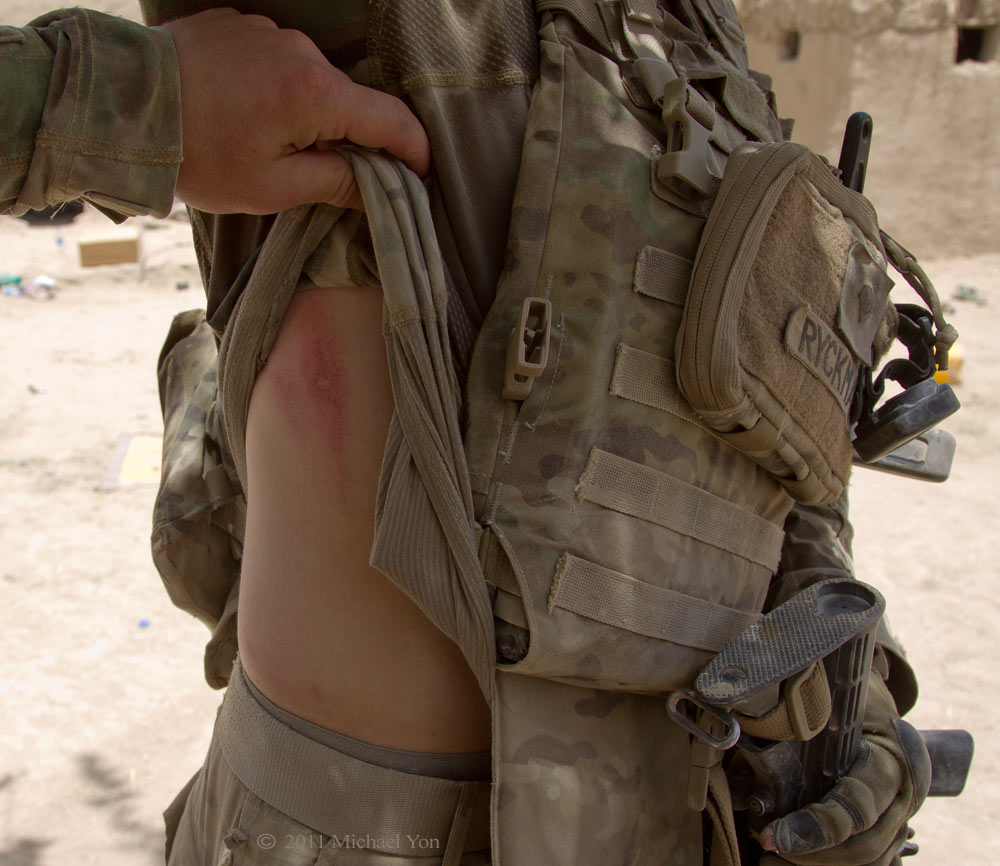
In addition to all of that, military forces on the ground have for a long time known that being shot is not a pleasant experience. One soldier reported that being shot in his side SAPI was as painful as being stabbed. Other soldiers have been recorded falling in momentary pain and shock after being shot, only to immediately get back up. While it's true soldiers have reported rounds bouncing off their vests without anything more than discomfort, it's fairly clear that it's a roll of the dice as to how bad, and how painful, a given impact will be, and whether you'll be able to stay standing at the end of it.

It's for these reasons I think that ballistic armor in GURPS, whether rigid or soft, should never leave you with the ability to simply "laugh off" bullets. Ballistic armor gives you a much better chance of survival, and often means you can get right back up again, but being shot often makes one fall down and scream in agony even the same.

Usage


So, how do we adapt the SEP system in such a way that blunt trauma through ballistic armor is simulated, even if only roughly? Fortunately, a rough implementation is very easy to put into practice:

-Flexible ballistic armor has 2/3rds of its DR converted into EP (round up). This would render a DR 12 vest into DR 4, EP 8. This means a major wound is possible if higher than average damage is rolled, but not on the average roll.

-Rigid ballistic armor, like a trauma plate, has 1/3rd of its DR converted into EP (again, rounding up). This would render a DR 35 trauma plate into DR 23, EP 12.

-When dealing with combined forms of armor, such as a trauma plate inside of an assault vest, add the EP values together and compare the remaining damage to the EP after the shot contends with each layer's DR separately. This is to make sure that different layers of armor actually work together properly to help stop shots, as otherwise each layer would break in sequence instead of working together to absorb force.

Example: Fred the Infantryman is shot for 30 damage in the vitals, close to maximum damage! He is wearing an assault vest (DR 4, EP 8 and a SAPI plate (DR 15, EP 8). The shot first contends with the trauma plate, which subtracts 15 points of damage, leaving 15 left over. Then the shot contests with the vest, which subtracts 4 points of damage, leaving 11 left over. The remaining 11 is compared to the total EP value (8+8, for EP 16). Since the damage is less than the combined EP from all layers of his armor, the shot does not penetrate, and the 11 points of damage are converted to crushing. Fred is saved from a killing shot.

To show why doing it the 'regular' way won't work, consider: If the layers are treated separately with regards to EP, the SAPI plate absorbs 15 points of damage, and then compares the remaining 15 with its EP of 8, which means the trauma plate breaks. The remaining 15 points of damage are then compared to the assault vest's DR 4, EP 8. The remaining 11 points of damage breaks through the vest as well, killing poor Fred. This is at odds with reality, as even the original SAPI, working in concert with a ballistic vest, can easily stop a 30-damage shot.

-When dealing with alternate DR values for different attack sources, apply the same rule to them. For instance, an assault vest would have DR 4 against a knife attack or a swung mace in regular High-Tech rules, so under this rule that would become DR 1, EP 3, allowing an 'average' knife attack to be shrugged off, but little else.

-Stab vests and other melee resistant armor should use the regular SEP system, treating themselves as cloth armor, unless the GM wants to avoid extra complexity. This is because DR 5 is too low to represent how an average stab vest functions - a GURPS character can break that by rolling max damage, when many real stab vests are capable of handling things off the end of the scale. If the GM desires to avoid excess complexity, simply treat them as flexible armor, as found here.

This system has the very nice effect of neatly simulating how armor behaves when struck by a threat too intense for it. In regular GURPS, a DR 12 pistol vest knocks off 12 damage even from rifle rounds, when in real life, a pistol vest confronted by a rifle round stops very little, if any at all, of the incoming round's velocity before it breaks. Here, it would only knock off 4 points of damage, with the majority of the vest's potential going to waste - this means a pistol vest will not help you survive against rifles!

This approach still has the same problem as the original low-tech SEP system, as it's still a bit too easy to kill someone through armor. Sadly, without changes to the injury rules, it's difficult to give an armor wearer a major wound that means he will fall to the ground for a moment without risking killing him with several shots. This means a story like that of Paul Ray Smith is very hard to duplicate - for a man to take 13 rifle rounds to the chest and back would require all of them to roll low damage, which is possible but unlikely.

Still, I think this system makes gunfights more interesting when armored soldiers cannot simply shrug off being hit. I am still working on these rules, and welcome any feedback or commentary on how to simulate BABT easily in GURPS. Keep on firing!

Friday, 11 April 2014

Super Edge Protection, Part 1: Adding to the GURPS DR system


"I could not begin to describe the crowd of those who were hit and wounded...
 ...as to those wearing an armor, they were exempted from wounds but not from bruises..."
 -Galbert of Bruges on the seige of Bruges (1127-1128)

In my last post, we covered my rationale for creating higher-definition rules for simulating armored combat in GURPS. To sum up, here are the problems I covered in that post with the way GURPS normally handles armor:
  • 'Death by peritonitis' - Armor only lets a few points of damage through at a time. It never fails catastrophically.
  • Armor is much weaker than it was historically, and it's far too easy to get a penetration in general.
  • There is no way to hurt or stun people through their armor without 'penetrating' it, mechanically.
  • There is no advantage given to penetrating armor in any given position or circumstance, including when thrusting instead of striking, or when the target is prone.

There are two interesting systems that have already been created to partially solve these issues: The original Games Diner Edge Protection house rule, and Blunt Trauma and Edged Weapons from Low Tech (p102). Both of these systems have the same idea at their core: Splitting the DR system into two things, Damage Reduction (DR) and Edge Protection (EP). DR subtracts damage normally from incoming damage, and if the remainder does not exceed the Edge Protection, it is converted into crushing damage. Thus, the target still takes damage even on a non-penetration, but it has no wounding modifier - the armor protected him by converting the excess energy into blunt trauma. This keeps deadly attacks away from the vitals as well.

The original Games Diner post suggests taking part of the existing DR for 'mundane' armor and replacing some of it with EP. I don't like this, as it doesn't solve point #1, #2 or #4. Blunt Trauma and Edged Weapons instead 'adds on' EP to the end of the existing armor - or, as they phrase it, see if the damage could penetrate twice the armor's DR, and if it can't, the damage is converted to crushing. However, this is only versus cutting damage. I felt that this was too limited, but it had whinged dangerously close to something workable.

So, I started modifying this system of "EP based on a multiplier of your existing DR" into something of my own, which I call Super Edge Protection. The objectives of this system are:
  • Make armor tougher and better able to resist weapons.
  • Despite the added toughness, characters in armor should be able to be hurt and battered about. You still should feel like you want to make defense rolls.
  • Simulate catastrophic failures in a simple manner, meaning that armor that fails should fail spectacularly.
  • Make some damage types do better against armor than others, and also take position into account when penetration is considered.
  • Be simple, add only minimal complexity (no more than existing rules in the GURPS books) and easy to slap on to any existing game. 

While I haven't solved all of the issues I raised above (see Limitations, below), I feel the system can add a great deal to any armored fight, allowing for fighters to crack each other about the helmets and give each other concussions as they throw, arm lock and stab each other in the armpit.

Usage


Almost all armor has an Edge Protection value, which is derived from a multiple of its DR. The EP multiplier changes depending on the type of armor and the damage type received; for instance, plate armor has 3x its DR as EP versus cutting, but 2x its DR as EP versus impaling. (See Armor Types, below.) DR subtracts normally from damage. If basic damage taken to an armored location exceeds the DR for the armor, but not the EP for that damage type, all the remaining damage is converted to crushing. If the damage is already crushing, EP has no effect.

If the incoming damage exceeds the combined DR+EP for that damage type, the armor is penetrated, and the EP doesn't apply.

Example: Bob the Knight is wearing heavy plate (2x versus imp, 3x vs cut) plate armor on his torso, and he is struck by a swung greatsword, being wielded by a supremely strong orc. The orc does 20 points of cutting damage, which is reduced to 11 points of damage after subtracting the DR. The armor's EP versus cutting is triple its DR (9 x 3 = 27 EP). Since this is is more than the remaining damage of 11, the damage is converted to crushing. Bob gets knocked back one yard and has to make a check for Knockdown and Stunning, and likely now has a huge dent in his armor, but he is alive - his armor saved his life.

Another example: Bill the Squire is wearing Fine Mail (DR 4, 1x versus imp, 2x vs cut). Bill is struck by a strong spear thrust that deals 10 points of impaling damage to his vitals. Since this is more than the chainmail's DR+EP of 8 (1x versus imp, so EP 4), the armor breaks, and the EP doesn't apply - 6 points of impaling damage gets through to poor Bill's vitals!

All crushing damage taken through this mechanic functions as damage dealt from a crushing weapon - in other words, if you're using New Hit Locations (MA137) and are struck in the vitals for one point of crushing damage past EP, you must make an unmodified HT roll for knockdown and stunning (HT-5 if damage exceeded HP/2). This means a strike to a sensitive location through armor can pay dividends, even if it did not penetrate. Try going for your opponent's vitals, skull or face!

This approach significantly toughens armor from the GURPS norm. It will be difficult to finish an opponent by simply striking him, even for a strong character. It's recommended to use this rule along with Harsh Realism - Armor Gaps (LT p101), or finishing opponents will be difficult.

Note that this multiplier is taken after any armor divisors or any other factors affecting DR - an attack with an AD of 2 would halve the DR, thus halving the EP along with it. This includes when targeting chinks in armor - weak points in armor are also poor at spreading incoming force out.


Armor Types


Source
Under this system, each armor type has a different multiplier for its EP value against impaling damage and cutting damage. They are separated into broad categories as follows:

Fibrous armor such as padded cloth, layered cloth, paper and straw armor gain 1x their DR as EP versus impaling damage, but gains no EP versus cutting damage. These armors are surprisingly good against arrows and stabbing weapons, but don't hold up well against swordsmen... (But see Cloth Armor Divisors, below.)

Leather armor of any type gains 1x its DR as EP versus cutting, but no EP versus impaling damage. Leather holds up well against a cut, but can be split apart by a point. 

Mail, scale, brigandine, segmented plate and any other non-homogenous metal armor gain 1x their DR as EP versus impaling and 2x their DR as EP versus cutting. It's virtually impossible to cut through these armor types - you're more likely to drive mail into the bones of its wearer than you are to cut through it! Thrusts, especially from a Defensive or Reversed Grip (or perhaps even both) may have an easier time of it, but it won't necessarily be easy...

Plate armor, whether bronze or iron or steel, provides 2x its DR as EP versus impaling, and 3x versus cutting. The best one will ever do swinging or even thrusting at a man in homogenous plate of any type is batter him around, unless one has serious hardware...


Rule Switches 


The following rules are all optional (or at least, even more optional than the SEP system itself), but can add even more depth and complexity to armored swordfighting:

Fixed Penetration - One of the reasons for armor having the ability to convert excess damage into blunt trauma is the armor's ability to recoil along with the wearer. By allowing energy to go into movement and into the wearer, the armor can avoid catastrophic failure much easier. This advantage is denied to a fighter who is unfortunate enough to find himself prone, or pinned against an object (not merely grappled, as that still allows them to move). In any such situation where a character is completely immobile and braced against an object, such as the ground, or a wall, both DR and EP are halved. This is cumulative with striking a chink, for a quarter of the DR, and thus EP! This gives huge dividends for wrestling or battered armored targets down to the ground before attempting to penetrate their armor.

Bulletproofing - While it is hard to get numbers that approximate the reality of low-tech armor performance against piercing projectiles such as bullets without adding more complexity, Low-Tech armor should be able to resist guns better than its DR value indicates - plate armor was very good against the handgonne and early muskets. Simply treat any armor's EP value against piercing as the same as its value versus impaling.

Cloth Armor Divisors - As shown in the test linked in the source image above, fibrous armor performs well against thrusted impaling weapons when the edges of the weapon are blunt. Attacks from thrusted edgeless weapons behave normally, but if the thrusted weapon has sharp edges (such as a non-Estoc sword), they gain an armor divisor of 2 against cloth armor. While the results of arrow attacks on such armors are still in question, at the GM's option, this may apply to impaling arrows as well - although there is some question about whether hunting broadheads would have gotten through the armor better. A bodkin point, however, would definitely have trouble against this type of armor.

Extra Knockback - In a cinematic game, armored targets getting knocked great distances might very well be an entertaining consequence, and may very well be in line with tales of legendary knights sending each other flying. Treat all crushing damage taken through the EP system as having double knockback!

  Benefits


"... among those was a fiery young fighter named Benkin, expert and swift in shooting arrows... ... And when he was aiming at the besiegers, his drawing on the bow was identified by everyone because he would either cause grave injury to the (unarmored) or put flight those who were (armored), whom his shots stupefied and stunned, even if they did not wound."
-The Murder of Charles the Good by Galbert of Bruges (1127)

While this system isn't perfect, all of the problems that I raised are tackled in at least some basic manner, and I feel this system ties up a lot of things quite neatly.

When armor breaks in this system, it breaks with great force - a character whose armor is penetrated will not be taking one point of impaling damage, but rather several, or perhaps even several dozen. If a character on a horse hits an armored enemy in the neck with an axe while at a full gallop and does 16 points of damage to his be-chainmailled neck, the enemy's head will go flying - anything less and the man will simply have his throat crushed. There is a steady progression of results on an armored target: No damage, blunt trauma, and catastrophic failure.
 
Armor is much tougher, and a man in a plate harness a terrifying threat, able to shrug off blows that would kill someone without armor. Yet at the same time, the same man can be laid low by a blow to his solar plexus or helmet and then finished with a stab to the visor. As well, armor is much better against cutting than impaling in this system, as one might expect - when leaping upon an armored foe, one would seek to drive his point into the enemy's chest and not his edge in the hopes of penetrating his mail.

Since crushing weapons tend to have higher basic damage in GURPS, they also have an inherent advantage in armored combat in this system, just like in history. EP does not affect crushing damage, so a mace would be an excellent tool to bring along to deal with armored targets and break their limbs through their armor.


Limitations


There are a few limitations to this system that I'm still struggling with. Given the need for these rules to remain streamlined and able to bolt onto any game with a minimum of effort, though, perhaps that's not surprising.

Perhaps most conspicuous is the failure to fully solve problem #3. While it is far more possible to damage people through their armor without penetrating it, the basic fact of having to penetrate your opponent's DR to hurt them is still there. If a sword pommeling to the side of the head or the neck - as shows up in fighting manuals of the period - fails to do more than 6 damage to a DR 6 helmet, nothing happens. I'm still considering means to fix this, but that's a topic for another ruleset.

Thanks to the naturally optimistic nature of GURPS damage, hopefully this will not be too much of an issue for the average adventurer (although it will be of issue for, say, a hobbit). However, the high damage in GURPS compared to what characters have for HP means that a character can only suffer a Major Wound four times before risking a death check, and only two before having to make an HT roll to stay conscious each round. This means that it is perhaps too easy to beat someone to death past their armor, especially if you have strong characters swinging at one another. Then again, depending on what type of game you're trying to run, perhaps this isn't so much a problem - this suits a Viking saga quite well.

Conclusion


Overall, I feel this system brings a lot to the table in terms of making armored combat in GURPS more interesting, promoting the combat paradigm of battering or grappling an opponent to the ground before finishing him, either through a gap or through brute force or simply through battering him so much that he dies, as many historical duels often went. Of course, arm locks aren't too effective versus armored adversaries in GURPS, but that's a topic for another post...

In part 3, we'll discuss applying the Super Edge Protection system to High-Tech armor, which deserves different treatment. Until then, may your sword shatter many be-mailled arm joints!

Tuesday, 8 April 2014

Super Edge Protection: Foreword


A brief foreword: In my efforts to develop and create a series of rules to better allow GURPS characters to have interesting armored swordfights, I have run into much opposition from others about the basic facts of how the system functions with regards to armor. Thus, before posting any rule that complains about how GURPS' DR systems are lacking and how I propose to change and fix them as optional rules, I felt that I should provide some background for my frustrations with the system and explain my rationale for my house rules.This post contains no rules - it should instead be considered a primer for the next part, which will contain the actual rules that I justify the need for here.

GURPS Damage Reduction is great. With the way DR normally works in GURPS, the 'bite' of most injuries is far reduced, allowing an armored character to keep his feet in the face of unlucky defense rolls. Armor is a huge force multiplier even in the most basic of GURPS games, even before Low-Tech came along to add one of the most fun-to-play-with armor systems I've seen in a tabletop RPG. However, even with Low-Tech's improvements on the system, there are still a few issues with it that make it really difficult to have a really interesting, engaging swordfight where armor is involved.

First and foremost, since DR is just a flat subtraction of damage, the result of someone being hit in armor is usually fairly predictable, barring any critical hits: Either the armor holds and the user takes no damage, the armor fails and lets some tiny amount of damage through. Usually, assuming a DR 6 plate and people with spears or swords and ST 10, this means that each party is doing 1d6+1 imp, giving them a 1-in-6 chance of doing a single point of damage past the armor. (This grows more likely as ST increases, of course.)

This means that between two combatants with their bodies covered head-to-toe in plates, fighting becomes a senseless whack-a-thon, with each party trying desperately to get a few points of damage past his adversary's armor. This can be partially fixed with the usage of Harsh Realism - Armor Gaps from Low-Tech (which I would highly recommend), but those gaps are extremely difficult to target, so oftentimes it will indeed come down to who can get enough attacks through the armor first. If you are playing a strong person, or the NPC you're fighting is a strong person, he may try to ignore gaps and simply hit you hard enough to 'crack' the armor, over and over again.

Now, let's stop and think about this for a minute in terms of the real world: If you are wearing a metal plate on your chest, and someone stabs you with a spear with his body weight behind it, is it really likely that the plate will fail and crumple inwards, but only the tippy-tip of the spear will penetrate for two points of injury? (1 point of base damage x 2 for imp) Armor usually fails in a much more 'cleanly' binary fashion - either the armor holds and little if any damage is sustained, or the armor experiences catastrophic failure and blows inwards, stopping very little, if any, of the energy of the attack. Taking a single point of basic damage through armor is a bit ridiculous. There are very few times where something will penetrate a metal plate, but won't have enough energy to penetrate the flesh underneath more than an inch. 'Death by peritonitis' is really quite unlikely.

You could say that the one-or-two-or-three damage penetrations that are occurring are really more like blunt trauma or non-penetrations, but with the way GURPS handles things mechanically, that doesn't make any sense. If there is poison on the spear when it does a single point of damage past your four-thousand-dollar plate cuirass, it's now in your bloodstream. You're vulnerable to infection. If you're using the Bleeding rules, you're now bleeding. By all aspects, mechanically, the enemy got through your armor.

We also have a second problem with creating an interesting armored swordfight in GURPS: The fact that when someone is struck in armor in GURPS, they take no blunt trauma. Armor is usually very good at preventing you from dying, but it can't simply make energy 'go away' - if you are struck by a polehammer to your midriff, all the energy in the blow hasn't gone away. It's simply been spread out across your body. Some of it turns into recoil, some of it goes into the armor, and some of it goes into a wide swathe of your bodily tissues. GURPS has almost no way of simulating this. No matter how or where or when you get hit, if the opponent doesn't roll enough damage to get past your DR, you take no damage.

"But wait!" You might say. "We have a blunt trauma rule already - it's in Campaigns!" Well, yes, we do. That rule allows you to do a single point of blunt trauma for every 5 points of damage that is blocked by the armor. Unfortunately, this rule is completely insufficient - it comes up in low-tech games so infrequently that it may as well not exist. Why? Well, the simple fact is - most low tech armors don't have DR over 5. All those flexible leather jerkins and cloth armors are functionally indifferent from rigid armor, since their flexible nature coming up in actual play is a physical impossibility (aside from the layering rules, at least). Heavy mail has a DR of 5, so if you roll 5 points of damage on the button, you get to do a single point of crushing damage to the target. Whoopee!

On top of that, the blunt trauma rule only applies to flexible armor, so it is a complete nonissue for plate armor, as in our example. Perhaps you see why I feel this rule is insufficient.

Finally, we have a pretty simple third problem: Thrusts have no advantage over cuts. In GURPS, thrusts do universally less damage thanks to not using leverage, which also means that they get through armor poorer than swings. This means that your best option for getting through armor is to swing your sword, not thrust it. This doesn't make any sense, because as the Poem of the Pell states:

And to thrust is better than to strike;
The striker is deluded many ways,
The sword may not through steel and bones bite,
The entrails are covered in steel and bones,
But with a thrust, anon your foe is forlorn;
Two inches pierced harm more
Than cut of edge, though it wounds sore.


Or, in plain English: Thrusts are way better at getting through armor than strikes, because they concentrate energy down onto a single point rather than spreading it out over an edge. GURPS also doesn't recognize any conditions where it is easier to penetrate armor, such as when a target is laying on his back, where he cannot recoil.

How do we fix all of this? These are the problems as I understand them:

  • 'Death by peritonitis' - Armor only lets a few points of damage through at a time. It never fails catastrophically.
  • Armor is much weaker than it was historically, and it's far too easy to get a penetration in general.
  • There is no way to hurt or stun people through their armor without 'penetrating' it, mechanically.
  • There is no advantage given to penetrating armor in any given position or circumstance, including when doing impaling instead of cutting, or when the target is prone.

While I haven't fully solved any of the problems that led me to create this post, I feel like the 'Super Edge Protection' system that I've come up with does do a good job at meeting these objectives and making armored swordfights more fun. The rules in question will be in my next post.