
"I could not begin to describe the crowd of those who were hit and wounded......as to those wearing an armor, they were exempted from wounds but not from bruises..."-Galbert of Bruges on the seige of Bruges (1127-1128)
In my last post, we covered my rationale for creating higher-definition rules for simulating armored combat in GURPS. To sum up, here are the problems I covered in that post with the way GURPS normally handles armor:
- 'Death by peritonitis' - Armor only lets a few points of damage through at a time. It never fails catastrophically.
- Armor is much weaker than it was historically, and it's far too easy to get a penetration in general.
- There is no way to hurt or stun people through their armor without 'penetrating' it, mechanically.
- There is no advantage given to penetrating armor in any given position or circumstance, including when thrusting instead of striking, or when the target is prone.
There are two interesting systems that have already been created to partially solve these issues: The original Games Diner Edge Protection house rule, and Blunt Trauma and Edged Weapons from Low Tech (p102). Both of these systems have the same idea at their core: Splitting the DR system into two things, Damage Reduction (DR) and Edge Protection (EP). DR subtracts damage normally from incoming damage, and if the remainder does not exceed the Edge Protection, it is converted into crushing damage. Thus, the target still takes damage even on a non-penetration, but it has no wounding modifier - the armor protected him by converting the excess energy into blunt trauma. This keeps deadly attacks away from the vitals as well.
The original Games Diner post suggests taking part of the existing DR for 'mundane' armor and replacing some of it with EP. I don't like this, as it doesn't solve point #1, #2 or #4. Blunt Trauma and Edged Weapons instead 'adds on' EP to the end of the existing armor - or, as they phrase it, see if the damage could penetrate twice the armor's DR, and if it can't, the damage is converted to crushing. However, this is only versus cutting damage. I felt that this was too limited, but it had whinged dangerously close to something workable.
So, I started modifying this system of "EP based on a multiplier of your existing DR" into something of my own, which I call Super Edge Protection. The objectives of this system are:
- Make armor tougher and better able to resist weapons.
- Despite the added toughness, characters in armor should be able to be hurt and battered about. You still should feel like you want to make defense rolls.
- Simulate catastrophic failures in a simple manner, meaning that armor that fails should fail spectacularly.
- Make some damage types do better against armor than others, and also take position into account when penetration is considered.
- Be simple, add only minimal complexity (no more than existing rules in the GURPS books) and easy to slap on to any existing game.
While I haven't solved all of the issues I raised above (see Limitations, below), I feel the system can add a great deal to any armored fight, allowing for fighters to crack each other about the helmets and give each other concussions as they throw, arm lock and stab each other in the armpit.
Usage
Almost all armor has an Edge Protection value, which is derived from a multiple of its DR. The EP multiplier changes depending on the type of armor and the damage type received; for instance, plate armor has 3x its DR as EP versus cutting, but 2x its DR as EP versus impaling. (See Armor Types, below.) DR subtracts normally from damage. If basic damage taken to an armored location exceeds the DR for the armor, but not the EP for that damage type, all the remaining damage is converted to crushing. If the damage is already crushing, EP has no effect.
If the incoming damage exceeds the combined DR+EP for that damage type, the armor is penetrated, and the EP doesn't apply.
Example: Bob the Knight is wearing heavy plate (2x versus imp, 3x vs cut) plate armor on his torso, and he is struck by a swung greatsword, being wielded by a supremely strong orc. The orc does 20 points of cutting damage, which is reduced to 11 points of damage after subtracting the DR. The armor's EP versus cutting is triple its DR (9 x 3 = 27 EP). Since this is is more than the remaining damage of 11, the damage is converted to crushing. Bob gets knocked back one yard and has to make a check for Knockdown and Stunning, and likely now has a huge dent in his armor, but he is alive - his armor saved his life.
Another example: Bill the Squire is wearing Fine Mail (DR 4, 1x versus imp, 2x vs cut). Bill is struck by a strong spear thrust that deals 10 points of impaling damage to his vitals. Since this is more than the chainmail's DR+EP of 8 (1x versus imp, so EP 4), the armor breaks, and the EP doesn't apply - 6 points of impaling damage gets through to poor Bill's vitals!
All crushing damage taken through this mechanic functions as damage dealt from a crushing weapon - in other words, if you're using New Hit Locations (MA137) and are struck in the vitals for one point of crushing damage past EP, you must make an unmodified HT roll for knockdown and stunning (HT-5 if damage exceeded HP/2). This means a strike to a sensitive location through armor can pay dividends, even if it did not penetrate. Try going for your opponent's vitals, skull or face!
This approach significantly toughens armor from the GURPS norm. It will be difficult to finish an opponent by simply striking him, even for a strong character. It's recommended to use this rule along with Harsh Realism - Armor Gaps (LT p101), or finishing opponents will be difficult.
Note that this multiplier is taken after any armor divisors or any other factors affecting DR - an attack with an AD of 2 would halve the DR, thus halving the EP along with it. This includes when targeting chinks in armor - weak points in armor are also poor at spreading incoming force out.
Armor Types
 |
| Source |
Fibrous armor such as padded cloth, layered cloth, paper and straw armor gain 1x their DR as EP versus impaling damage, but gains no EP versus cutting damage. These armors are surprisingly good against arrows and stabbing weapons, but don't hold up well against swordsmen... (But see Cloth Armor Divisors, below.)
Leather armor of any type gains 1x its DR as EP versus cutting, but no EP versus impaling damage. Leather holds up well against a cut, but can be split apart by a point.
Mail, scale, brigandine, segmented plate and any other non-homogenous metal armor gain 1x their DR as EP versus impaling and 2x their DR as EP versus cutting. It's virtually impossible to cut through these armor types - you're more likely to drive mail into the bones of its wearer than you are to cut through it! Thrusts, especially from a Defensive or Reversed Grip (or perhaps even both) may have an easier time of it, but it won't necessarily be easy...
Leather armor of any type gains 1x its DR as EP versus cutting, but no EP versus impaling damage. Leather holds up well against a cut, but can be split apart by a point.
Mail, scale, brigandine, segmented plate and any other non-homogenous metal armor gain 1x their DR as EP versus impaling and 2x their DR as EP versus cutting. It's virtually impossible to cut through these armor types - you're more likely to drive mail into the bones of its wearer than you are to cut through it! Thrusts, especially from a Defensive or Reversed Grip (or perhaps even both) may have an easier time of it, but it won't necessarily be easy...
Plate armor, whether bronze or iron or steel, provides 2x its DR as EP versus impaling, and 3x versus cutting. The best one will ever do swinging or even thrusting at a man in homogenous plate of any type is batter him around, unless one has serious hardware...
Rule Switches
The following rules are all optional (or at least, even more optional than the SEP system itself), but can add even more depth and complexity to armored swordfighting:
Fixed Penetration - One of the reasons for armor having the ability to convert excess damage into blunt trauma is the armor's ability to recoil along with the wearer. By allowing energy to go into movement and into the wearer, the armor can avoid catastrophic failure much easier. This advantage is denied to a fighter who is unfortunate enough to find himself prone, or pinned against an object (not merely grappled, as that still allows them to move). In any such situation where a character is completely immobile and braced against an object, such as the ground, or a wall, both DR and EP are halved. This is cumulative with striking a chink, for a quarter of the DR, and thus EP! This gives huge dividends for wrestling or battered armored targets down to the ground before attempting to penetrate their armor.
Bulletproofing - While it is hard to get numbers that approximate the reality of low-tech armor performance against piercing projectiles such as bullets without adding more complexity, Low-Tech armor should be able to resist guns better than its DR value indicates - plate armor was very good against the handgonne and early muskets. Simply treat any armor's EP value against piercing as the same as its value versus impaling.
Cloth Armor Divisors - As shown in the test linked in the source image above, fibrous armor performs well against thrusted impaling weapons when the edges of the weapon are blunt. Attacks from thrusted edgeless weapons behave normally, but if the thrusted weapon has sharp edges (such as a non-Estoc sword), they gain an armor divisor of 2 against cloth armor. While the results of arrow attacks on such armors are still in question, at the GM's option, this may apply to impaling arrows as well - although there is some question about whether hunting broadheads would have gotten through the armor better. A bodkin point, however, would definitely have trouble against this type of armor.
Extra Knockback - In a cinematic game, armored targets getting knocked great distances might very well be an entertaining consequence, and may very well be in line with tales of legendary knights sending each other flying. Treat all crushing damage taken through the EP system as having double knockback!
Benefits
"... among those was a fiery young fighter named Benkin, expert and swift in shooting arrows... ... And when he was aiming at the besiegers, his drawing on the bow was identified by everyone because he would either cause grave injury to the (unarmored) or put flight those who were (armored), whom his shots stupefied and stunned, even if they did not wound."
-The Murder of Charles the Good by Galbert of Bruges (1127)
While this system isn't perfect, all of the problems that I raised are tackled in at least some basic manner, and I feel this system ties up a lot of things quite neatly.
When armor breaks in this system, it breaks with great force - a character whose armor is penetrated will not be taking one point of impaling damage, but rather several, or perhaps even several dozen. If a character on a horse hits an armored enemy in the neck with an axe while at a full gallop and does 16 points of damage to his be-chainmailled neck, the enemy's head will go flying - anything less and the man will simply have his throat crushed. There is a steady progression of results on an armored target: No damage, blunt trauma, and catastrophic failure.

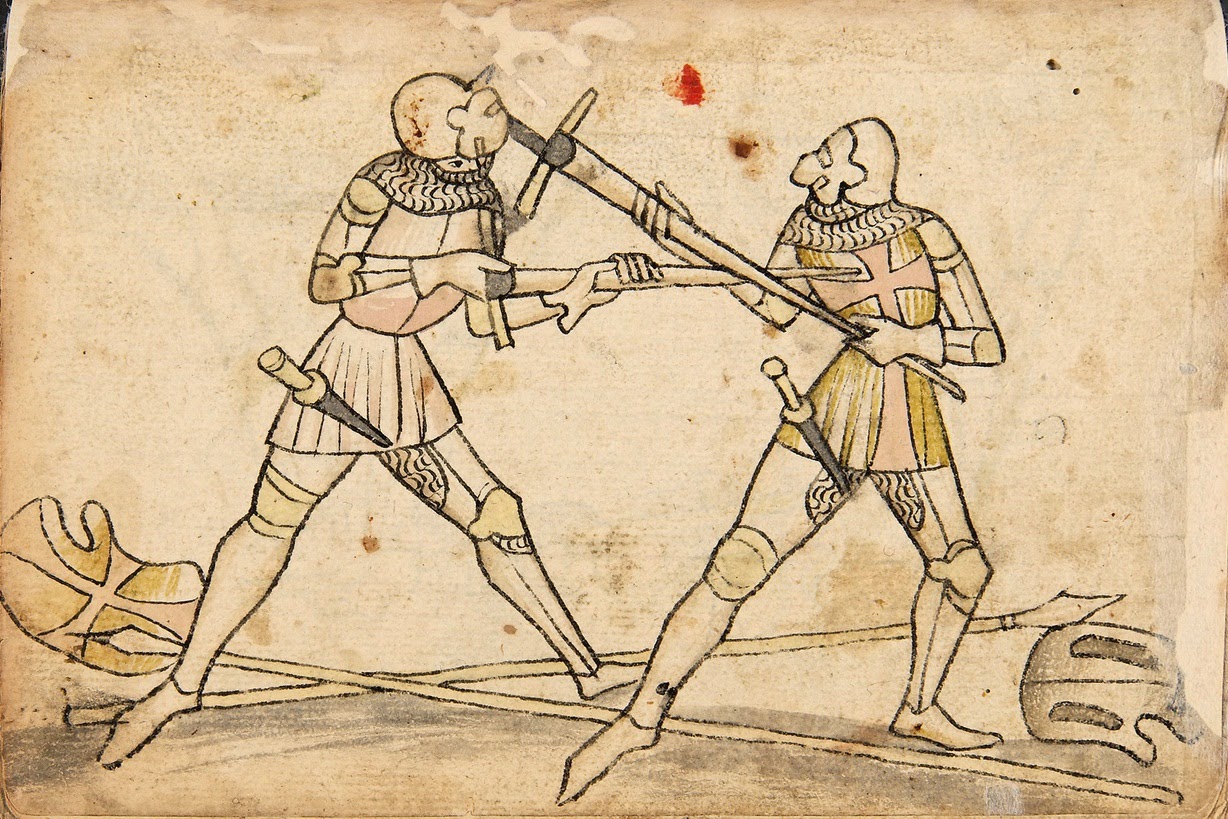
Armor is much tougher, and a man in a plate harness a terrifying threat, able to shrug off blows that would kill someone without armor. Yet at the same time, the same man can be laid low by a blow to his solar plexus or helmet and then finished with a stab to the visor. As well, armor is much better against cutting than impaling in this system, as one might expect - when leaping upon an armored foe, one would seek to drive his point into the enemy's chest and not his edge in the hopes of penetrating his mail.
Since crushing weapons tend to have higher basic damage in GURPS, they also have an inherent advantage in armored combat in this system, just like in history. EP does not affect crushing damage, so a mace would be an excellent tool to bring along to deal with armored targets and break their limbs through their armor.
Limitations
There are a few limitations to this system that I'm still struggling with. Given the need for these rules to remain streamlined and able to bolt onto any game with a minimum of effort, though, perhaps that's not surprising.
Perhaps most conspicuous is the failure to fully solve problem #3. While it is far more possible to damage people through their armor without penetrating it, the basic fact of having to penetrate your opponent's DR to hurt them is still there. If a sword pommeling to the side of the head or the neck - as shows up in fighting manuals of the period - fails to do more than 6 damage to a DR 6 helmet, nothing happens. I'm still considering means to fix this, but that's a topic for another ruleset.
Thanks to the naturally optimistic nature of GURPS damage, hopefully this will not be too much of an issue for the average adventurer (although it will be of issue for, say, a hobbit). However, the high damage in GURPS compared to what characters have for HP means that a character can only suffer a Major Wound four times before risking a death check, and only two before having to make an HT roll to stay conscious each round. This means that it is perhaps too easy to beat someone to death past their armor, especially if you have strong characters swinging at one another. Then again, depending on what type of game you're trying to run, perhaps this isn't so much a problem - this suits a Viking saga quite well.
Overall, I feel this system brings a lot to the table in terms of making armored combat in GURPS more interesting, promoting the combat paradigm of battering or grappling an opponent to the ground before finishing him, either through a gap or through brute force or simply through battering him so much that he dies, as many historical duels often went. Of course, arm locks aren't too effective versus armored adversaries in GURPS, but that's a topic for another post...
In part 3, we'll discuss applying the Super Edge Protection system to High-Tech armor, which deserves different treatment. Until then, may your sword shatter many be-mailled arm joints!
Conclusion
In part 3, we'll discuss applying the Super Edge Protection system to High-Tech armor, which deserves different treatment. Until then, may your sword shatter many be-mailled arm joints!

_107v.jpg)
